
World news
One Indian Sailor Killed, Six Injured as Iranian Missiles Hit UAE Oil Tankers in Strait of Hormuz
By MILLENNIUM NEWSROOM Desk · Published: Jul 14, 2026 05:03 PM
3 min read
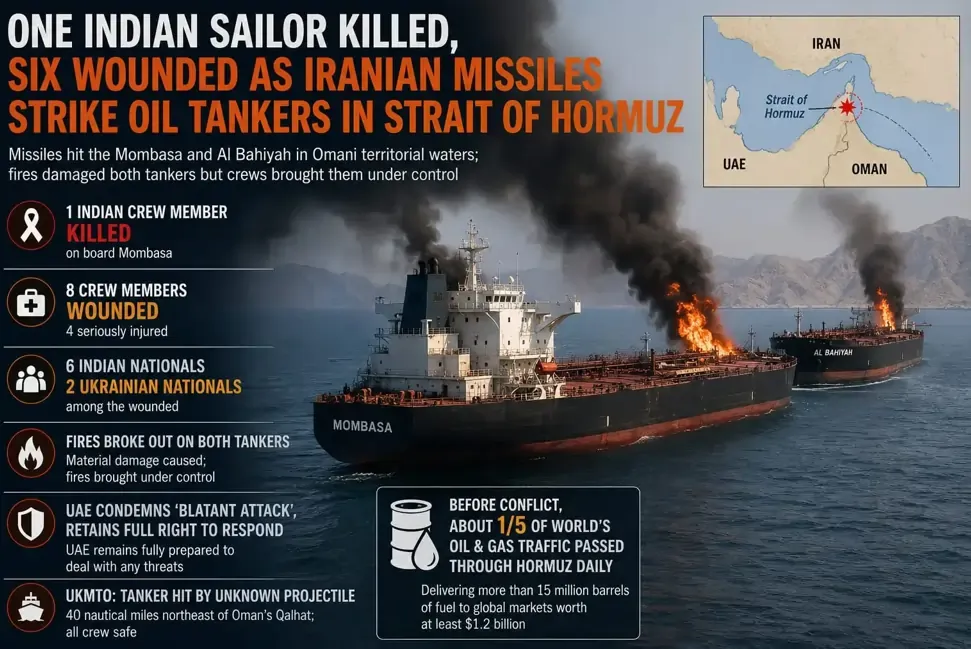
One Indian crew member was killed and six other Indian nationals were injured after two Emirati oil tankers were struck by Iranian cruise missiles in the Strait of Hormuz on Tuesday (July 14, 2026), according to the United Arab Emirates Ministry of Defence. The incident marks a major escalation in tensions across one of the world's most critical maritime trade routes.
The ministry said the two tankers, Mombasa and Al Bahiyah, were targeted while sailing in the southern lane of the Strait of Hormuz within Omani territorial waters. The Indian sailor who lost his life was serving aboard the Mombasa.
Eight Crew Members Injured in Missile Strike
According to the UAE Ministry of Defence, eight crew members sustained injuries during the attack, including four who were seriously wounded. Of those injured, six are Indian nationals while the remaining two are Ukrainian nationals.
The missile strikes triggered fires aboard both vessels, causing material damage. Authorities said the fires were successfully brought under control, preventing further damage to the tankers.
"The UAE retains its full right to respond to this escalation," the Ministry of Defence said, condemning the missile strike as a "blatant attack."
The ministry added that the UAE remains fully prepared to counter any threats and will take all necessary measures to safeguard the country's security and stability.
UK Maritime Agency Reports Separate Tanker Strike
Separately, the United Kingdom Maritime Trade Operations (UKMTO) reported that a tanker travelling approximately 40 nautical miles northeast of Oman's Qalhat was struck by an unidentified projectile.
According to UKMTO, the vessel's master reported that the projectile hit the starboard-side engine room. All crew members aboard that vessel were reported safe.
Reuters could not immediately verify whether the UKMTO report referred to the same incident involving the UAE tankers. Iran had not issued any official comment on the attacks at the time of publication.
Regional Tensions Continue to Escalate
The latest attack comes amid weeks of heightened military tensions following the conflict that erupted on February 28, when the United States and Israel launched attacks on Iran.
On Monday, U.S. President Donald Trump announced that Washington was reinstating its blockade of Iranian shipping in the Gulf and would ensure the Strait of Hormuz remained open for international navigation, while warning of further military action against Iran following renewed missile and drone exchanges.
Iran's top joint military command rejected the U.S. position, stating that Washington had no authority over the future of the strategic waterway and would not be allowed to intervene. The ongoing conflict has expanded across the region, with Iran targeting U.S. military bases in multiple countries, raising concerns over regional stability.
Global Energy Supply Faces Fresh Uncertainty
Before the conflict began earlier this year, nearly one-fifth of the world's oil and gas shipments passed daily through the Strait of Hormuz. The strategic passage handled more than 15 million barrels of fuel each day, valued at over $1.2 billion, making it one of the most vital energy corridors for global markets.
(AI generated Image)